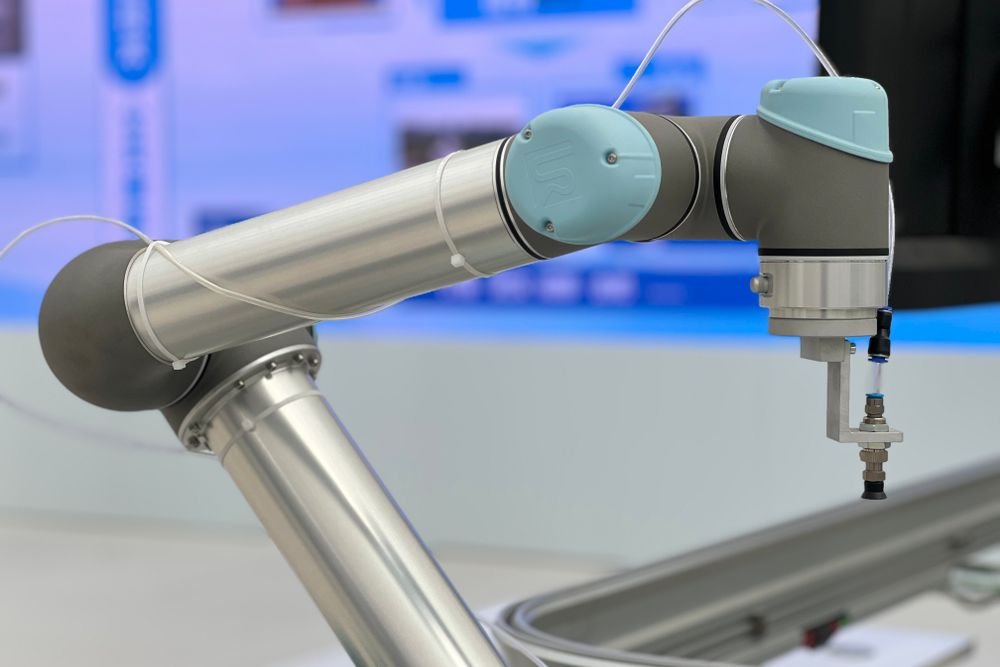
Collaborative robotic applications depend on the coordinated operation of several technologies rather than on the robot arm alone. Sensors provide information about the environment, grippers interact with physical objects, and control software determines how the system responds. When these components are integrated correctly, a collaborative robot can perform handling, assembly and machine-tending operations with greater consistency. Understanding how the technologies exchange information is essential for designing a dependable cobotic workstation.
Understanding the Architecture of a Cobotic Workstation
A typical cobotic workstation contains a robot controller, an end effector, input devices and application-level control logic. The robot controller manages motion execution, while external devices supply information about workpieces, machines and process conditions. The application software coordinates these elements to perform a defined production task.
For example, a cobot loading components into a testing machine may need to identify a component, confirm that the machine is ready and verify that the gripper has secured the workpiece. Each condition influences the next permitted action. The system should not begin moving a component into the machine until the required process and safety conditions have been satisfied.
Sensors Turn Robot Movements Into Responsive Operations
Without external sensing, a robot generally depends on programmed positions and information already available through its controller. Sensors allow the automation system to respond to variations that cannot be handled reliably through fixed coordinates alone. Their selection depends on what the application needs to detect and how accurately that information must be measured.
Vision systems can identify object positions, orientations and certain visible defects. Force and torque sensors can provide information about physical contact, while proximity sensors can detect the presence of objects within a defined range. Encoders and other position-measurement devices help synchronise robot operations with moving equipment. Each sensor introduces its own accuracy limits, response characteristics and environmental requirements.
Combining Vision and Gripping Feedback
Consider a cobot handling randomly positioned components in a tray. A vision system may locate a suitable component and calculate its orientation, allowing the robot to approach it from an appropriate direction. The gripper then closes or activates its vacuum function, and feedback indicates whether the grasp was completed as expected.
If the grip is unsuccessful, the control software may initiate a predefined retry procedure. This could involve repositioning the robot, selecting another component or notifying an operator after repeated failures. Reliable recovery depends on distinguishing between a temporary handling error and a condition that requires human intervention.
Grippers as Intelligent Components of the System
Modern end effectors can provide more functionality than a simple mechanical gripping action. Depending on their design, they may offer adjustable gripping force, position feedback, object detection or programmable operating modes. These capabilities allow control software to adapt handling parameters to different workpieces.
Solutions associated with Onrobot cobotics illustrate the broader role of end-of-arm tooling within collaborative automation. The integration challenge is to ensure that the selected gripper communicates effectively with the robot and provides the feedback required by the application. A tool may be mechanically compatible with a cobot while still requiring additional configuration or software integration to support the intended workflow.
For delicate products, adjustable gripping parameters can be particularly important. A workstation handling both rigid components and flexible packaging may require different contact forces or gripping methods. Software-controlled settings can reduce the need for manual adjustments, provided the tool supports the necessary operating range.
Robot Control Software Coordinates the Workflow
Sensors and grippers become useful as an integrated system when their information is incorporated into the robot’s control logic. The software must interpret input signals, manage task sequences and determine how to respond to expected variations. It also needs to communicate with surrounding equipment, including conveyors, inspection systems and machine controllers.
Industrial communication protocols such as OPC UA, PROFINET and EtherNet/IP can support information exchange between compatible devices. However, using a common protocol does not automatically establish a complete application-level integration. Engineers must still define the meaning of exchanged data, expected response times and the behaviour of the system when communication fails.
A well-designed application separates routine process logic from safety-related control functions. For example, a standard sensor may help determine whether a component is present, but it should not be treated as a safety-rated protective device unless it is specifically designed and integrated for that purpose. Collaborative operation requires a risk assessment of the complete application, including tooling, workpieces and human interaction.
A Practical Example: Automated Machine Tending
In a machine-tending application, a cobot may collect an unfinished component from a tray and load it into a CNC machine. A sensor or machine interface confirms that the machining area is available, while the gripper secures the component for transfer. After loading, the robot moves to an appropriate position and the machine begins its processing cycle.
When machining is complete, the workstation receives a machine-ready signal and initiates the unloading sequence. The gripper removes the finished component, which may then be placed in an inspection station or output tray. Sensors verify relevant process conditions at each stage, helping the system identify missing parts or unsuccessful handling operations.
The workflow becomes more complicated when several product variants are processed on the same equipment. Different components may require separate gripping parameters, placement coordinates and inspection criteria. Application software can manage these differences through validated recipes or task configurations, reducing the amount of manual reprogramming required between production batches.
Designing for Reliability and Future Changes
An effective cobotic application should be designed around predictable responses to real production conditions. Engineers need to consider sensor contamination, variations in workpiece geometry, communication interruptions and mechanical wear. Maintenance procedures should also include checking gripper condition, sensor calibration where required and the integrity of electrical or pneumatic connections.
Modularity can make future modifications easier by allowing sensors, grippers or software functions to be replaced without redesigning the entire workstation. Nevertheless, every change must be checked for mechanical, electrical, functional and safety compatibility. A new gripper or sensor may alter the behaviour of an otherwise familiar application.
The practical value of cobotics comes from coordinating perception, physical manipulation and control into a dependable process. Sensors help the system understand relevant conditions, grippers perform the required physical interaction, and software connects these functions into an executable workflow. Successful integration depends on treating all three as interdependent parts of the same automation system.